
Friday, January 16, 2009
Fire Extinguisher
Part number 554449, available new from your Stanpart Accessories Brochure in the 1960s. Always better to be safe than sorry!


Draftman's Board Ruler
We are indebted to Roy Ford (former Triumph Experimental Dept) for donating this draftman's board ruler.
Taken from one of the drawing boards in the Triumph design studios upon the closure of the Canley plant. How many cars were designed using this - what stories could it tell?

Taken from one of the drawing boards in the Triumph design studios upon the closure of the Canley plant. How many cars were designed using this - what stories could it tell?

Spitfire ADU 4B Le Mans
Commission number (1964) X727, engine number (1964) X935E, registered 01.06.64. Described in prototype department build sheets as 'Le Mans No1'.
 ADU 4B as revealed when removed from container at Felixstowe after arrival in the UK from the USA in 2004.
Picture courtesy of James Carruthers
 ADU 4B 1965 Le Mans pre race and the late great Harry Webster
 Le Man 1965
 ADU 4B Sebring 1965
(Peter Clarke works mechanic to right of image)
 ADU 4B Sebring 1965 Pit Stop
Picture courtesy David E Feuerhelm
David's father Duane drove 4B at Sebring in 1965
 ADU 4B at the Swiss Hill Climb Mittholz - Kandersteg Sept.1965
Thuner at the wheel first in his category
(Picture courtesy Daniel Senn)
 ADU 4B at the end of the 1965 season with the drivers from the
Leyland Triumph Swiss Racing Team.
On the right is JJ Thuner Swiss Championship winner 1965.
(Picture courtesy Daniel Senn)
 ADU 4B showing hasty repairs following accident whilst in Switzerland in the 1980's
 ADU 4B in the USA in 2002
whilst in the custodianship of Vern Brannon
(929 HP Le Man TRS behind)
Picture courtesy of Howard Baugues
 ADU 4B as revealed when removed from container at Felixstowe after arrival in the UK from the USA in 2004.
Picture courtesy of James Carruthers
 ADU 4B 1965 Le Mans pre race and the late great Harry Webster
 Le Man 1965
 ADU 4B Sebring 1965
(Peter Clarke works mechanic to right of image)
 ADU 4B Sebring 1965 Pit Stop
Picture courtesy David E Feuerhelm
David's father Duane drove 4B at Sebring in 1965
 ADU 4B at the Swiss Hill Climb Mittholz - Kandersteg Sept.1965
Thuner at the wheel first in his category
(Picture courtesy Daniel Senn)
 ADU 4B at the end of the 1965 season with the drivers from the
Leyland Triumph Swiss Racing Team.
On the right is JJ Thuner Swiss Championship winner 1965.
(Picture courtesy Daniel Senn)
 ADU 4B showing hasty repairs following accident whilst in Switzerland in the 1980's
 ADU 4B in the USA in 2002
whilst in the custodianship of Vern Brannon
(929 HP Le Man TRS behind)
Picture courtesy of Howard Baugues
Thursday, January 15, 2009
New Year Lots of New Product!
You may be forgiven for thinking that we have been a little quite on the new product development/introduction front of late. Nothing could be further from the truth, and since employing a graduate of motorsport engineering and design (and a Triumph enthusiast to boot) things moved up a gear last year. Due to website glitches soon to be sorted we have been a little slow in keeping you informed of progress, hopefully we will be a little bit more forthcoming this year.
Having CAD facilities in house has been a revelation. Not having to rely on outside agencies means that we can now design, modify, and prototype in our timescale, not someone else's. When I say we by the way I put less emphasis on myself, I just come up with some of the ideas, someone else translates them into potential product using the magic box in the corner of the office. The trouble now is reigning in our ambitions. Having someone here who is as mad keen as me with as many if not more ideas could get expensive.
As a result of the above we have started looking at other models in the Triumph range, watch out for new bits for the 2000/2.5 range, and the 6 cylinder TR's this year.
We haven't forgotten our roots either and a major new panel launch is imminent for the Vitesse (yes that one!). This could possibly be the swan song for new panel introduction for the small chassis Triumph's as panelwork sales have taken a nose dive over recent years. Spitfire panelwork sales in particular are worryingly low, and I think we may look back at this time in the near future and regard it as a hiatus in availability. If things continue as they have been for the last couple of years or so I can see us losing some panels for ever.
Anyway lets not end on a low note I for one am encouraged by the new blood, and new ideas around at the moment it's keeping us old so and so's on our toe's. Who'd have thought that this long after Triumph disappeared we would still be using the latest technology to turn dream into reality?
Having CAD facilities in house has been a revelation. Not having to rely on outside agencies means that we can now design, modify, and prototype in our timescale, not someone else's. When I say we by the way I put less emphasis on myself, I just come up with some of the ideas, someone else translates them into potential product using the magic box in the corner of the office. The trouble now is reigning in our ambitions. Having someone here who is as mad keen as me with as many if not more ideas could get expensive.
As a result of the above we have started looking at other models in the Triumph range, watch out for new bits for the 2000/2.5 range, and the 6 cylinder TR's this year.
We haven't forgotten our roots either and a major new panel launch is imminent for the Vitesse (yes that one!). This could possibly be the swan song for new panel introduction for the small chassis Triumph's as panelwork sales have taken a nose dive over recent years. Spitfire panelwork sales in particular are worryingly low, and I think we may look back at this time in the near future and regard it as a hiatus in availability. If things continue as they have been for the last couple of years or so I can see us losing some panels for ever.
Anyway lets not end on a low note I for one am encouraged by the new blood, and new ideas around at the moment it's keeping us old so and so's on our toe's. Who'd have thought that this long after Triumph disappeared we would still be using the latest technology to turn dream into reality?
Spitfire Gold Seal Racing
This is possibly the only surviving Gold Seal Racing plastic Spitfire.
We were privileged to acquire this car from Richard Lloyd himself, who delivered the car to us aided by his race mechanic Peter Clarke (ex Triumph competition dept). Richard had tracked the car down with the help of Julius Thurgood classic car dealer (Julius has since informed us that he saw it in an advert in Exchange & Mart in 1984), and latterly the Top Hat race series organiser. Previous to this it had sat in a barn on a farm for many years in an unloved state. Unfortunately by the time we acquired the car it was engineless its original 70X engine having gone into a new car that Peter Clarke had built up for Richard to go racing in. They (Peter & Richard) having decided that it would be too difficult to enter an all plastic Spitfire in any established race series decided to build the new car up around a steel tub with aluminium outer panel-work (we supplied the tub and the alloy panels). As a result the glass-fibre car was now redundant and seemed unlikely to ever race again hence our acquisition.
 Period shot of car with Richard Lloyd at the helm
(courtesy of Richard Lloyd, it's his autograph on the front cover!)
Earlier in it's history our car had been owned by Terry Hunter (former works rally driver for Triumph) who had bought the car directly from Triumph after its works competition career ended, he in turn passed it on to Peter Clarke who then comprehensibly rebuilt it for Richard Lloyd into the plastic Spitfire we see today. The only major steel part of the car, the bulkhead is probably all that is left of one of the original prototype Spitfires built by Triumph prior to production.
 Later in the cars racing career when it acquired it's blue nose.
For those of you who were unaware of Team Gold Seal here is a brief history.
Gold Seal Car Company Limited (a London based sports car dealers) sponsored a team of 3 drivers and cars, the drivers being Peter Cox, Richard Lloyd, and Chris Marshall. Peter Cox needs little introduction as he was a prime mover in the factory competitions dept in the 1960s during the Spitfire racing/rallying years. Peter went on in 1967 to win the Freddy Dixon trophy in the ex Stirling Moss, Smart Spitfire ADU 467B. Indeed a highly modified ADU 467B was Peter's first Gold Seal sponsored car for the 1968 season.
 Servicing at the Mugello Circuit 1969
Richard Lloyd at the time was working for Peter Gormley Management Limited looking after Cliff Richard, The Shadows, and others, very 1960s! Richard went on to be a highly successful racing team manager including the Team Bentley Le Mans effort recently.
 Mugello 1969
Chris Marshall sold sports cars for a living, whilst in his free time he raced saloon cars (A40s, Minis, Anglias), until he converted to Spitfires.
The cars themselves were radically modified Spitfire's even by today's standards.
Eventually all three cars sported all plastic (glass-fibre) body-shells, bonnets, etc. Even the boot lids were 'glassed' in with integral glass-fibre hinges to complete the effect! The only 'metal' parts of the car ended up being the bulkhead and floors, yes even the sills were glass-fibre!
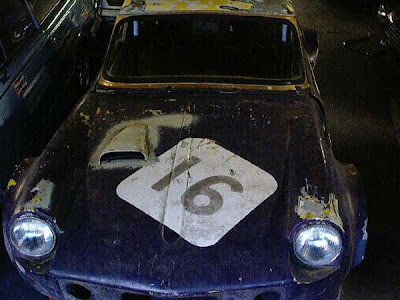 As delivered to us, and much as Julius Thurgood found it in 1984
after purchasing it from an advert in Exchange & Mart
All of this glass-fibre work was carried out by Chris Williams of Windmill Plastics here in Coventry, and indeed all of the cars carried Chris Williams sponsorship decals on their rear quarters.
All three cars were built and maintained by Peter Cox, and Peter Clarke who was also a 'works' competition dept mechanic heavily involved in the Spitfire effort.
 All it needs is an engine, oh and a major restoration!
In 1969 Team Gold Seal entered two cars in the International Mugello Grand Prix for sports cars, run on the Mugello road circuit near Florence. Entered in the 1000cc class this entailed sleeving down the 1200cc 70X engines to 998cc. The two cars were entry number 54 (blue nose car), and entry number 55 (yellow nosed car). Unfortunately Pete Cox crashed the yellow nosed car very heavily in practice, so much so that all they brought of it away from the event afterwards was the engine (this engine subsequently got fitted to a Formula Junior style racer but was never very successful in this form), and a few other mechanical components. The blue nosed car raced in the event (driven by Chris Marshall & John Brittan) but suffered a puncture that put it out of the serious running.
It was this car that Julius Thurgood tracked down and sold to Richard Lloyd years later, and that we were lucky enough to acquire later still from Richard.
 Gold Seal Racing : Peter Cox, Chris Marshall and Richard Lloyd
As it stands our car is in serious need of restoration, but it will be worth the effort, what a super part of Triumph racing history! The one stumbling block to an accurate restoration could have been sourcing a works 70X engine to replace the one removed by Peter in the course of building Richards new race car. However since we got the car we have found two genuine 70X motors, and enough components to build a third, so no problems there then. Now all we have to find is the time to do it.
We were privileged to acquire this car from Richard Lloyd himself, who delivered the car to us aided by his race mechanic Peter Clarke (ex Triumph competition dept). Richard had tracked the car down with the help of Julius Thurgood classic car dealer (Julius has since informed us that he saw it in an advert in Exchange & Mart in 1984), and latterly the Top Hat race series organiser. Previous to this it had sat in a barn on a farm for many years in an unloved state. Unfortunately by the time we acquired the car it was engineless its original 70X engine having gone into a new car that Peter Clarke had built up for Richard to go racing in. They (Peter & Richard) having decided that it would be too difficult to enter an all plastic Spitfire in any established race series decided to build the new car up around a steel tub with aluminium outer panel-work (we supplied the tub and the alloy panels). As a result the glass-fibre car was now redundant and seemed unlikely to ever race again hence our acquisition.
 Period shot of car with Richard Lloyd at the helm
(courtesy of Richard Lloyd, it's his autograph on the front cover!)
Earlier in it's history our car had been owned by Terry Hunter (former works rally driver for Triumph) who had bought the car directly from Triumph after its works competition career ended, he in turn passed it on to Peter Clarke who then comprehensibly rebuilt it for Richard Lloyd into the plastic Spitfire we see today. The only major steel part of the car, the bulkhead is probably all that is left of one of the original prototype Spitfires built by Triumph prior to production.
 Later in the cars racing career when it acquired it's blue nose.
For those of you who were unaware of Team Gold Seal here is a brief history.
Gold Seal Car Company Limited (a London based sports car dealers) sponsored a team of 3 drivers and cars, the drivers being Peter Cox, Richard Lloyd, and Chris Marshall. Peter Cox needs little introduction as he was a prime mover in the factory competitions dept in the 1960s during the Spitfire racing/rallying years. Peter went on in 1967 to win the Freddy Dixon trophy in the ex Stirling Moss, Smart Spitfire ADU 467B. Indeed a highly modified ADU 467B was Peter's first Gold Seal sponsored car for the 1968 season.
 Servicing at the Mugello Circuit 1969
Richard Lloyd at the time was working for Peter Gormley Management Limited looking after Cliff Richard, The Shadows, and others, very 1960s! Richard went on to be a highly successful racing team manager including the Team Bentley Le Mans effort recently.
 Mugello 1969
Chris Marshall sold sports cars for a living, whilst in his free time he raced saloon cars (A40s, Minis, Anglias), until he converted to Spitfires.
The cars themselves were radically modified Spitfire's even by today's standards.
Eventually all three cars sported all plastic (glass-fibre) body-shells, bonnets, etc. Even the boot lids were 'glassed' in with integral glass-fibre hinges to complete the effect! The only 'metal' parts of the car ended up being the bulkhead and floors, yes even the sills were glass-fibre!
 As delivered to us, and much as Julius Thurgood found it in 1984
after purchasing it from an advert in Exchange & Mart
All of this glass-fibre work was carried out by Chris Williams of Windmill Plastics here in Coventry, and indeed all of the cars carried Chris Williams sponsorship decals on their rear quarters.
All three cars were built and maintained by Peter Cox, and Peter Clarke who was also a 'works' competition dept mechanic heavily involved in the Spitfire effort.
 All it needs is an engine, oh and a major restoration!
In 1969 Team Gold Seal entered two cars in the International Mugello Grand Prix for sports cars, run on the Mugello road circuit near Florence. Entered in the 1000cc class this entailed sleeving down the 1200cc 70X engines to 998cc. The two cars were entry number 54 (blue nose car), and entry number 55 (yellow nosed car). Unfortunately Pete Cox crashed the yellow nosed car very heavily in practice, so much so that all they brought of it away from the event afterwards was the engine (this engine subsequently got fitted to a Formula Junior style racer but was never very successful in this form), and a few other mechanical components. The blue nosed car raced in the event (driven by Chris Marshall & John Brittan) but suffered a puncture that put it out of the serious running.
It was this car that Julius Thurgood tracked down and sold to Richard Lloyd years later, and that we were lucky enough to acquire later still from Richard.
 Gold Seal Racing : Peter Cox, Chris Marshall and Richard Lloyd
As it stands our car is in serious need of restoration, but it will be worth the effort, what a super part of Triumph racing history! The one stumbling block to an accurate restoration could have been sourcing a works 70X engine to replace the one removed by Peter in the course of building Richards new race car. However since we got the car we have found two genuine 70X motors, and enough components to build a third, so no problems there then. Now all we have to find is the time to do it.
2001 - Back Home in Coventry
It became common knowledge in Triumph circles in 1999/2000 that for the right money The Macau was available yet again. In 2001 we made our first tentative enquiry, checking the cars provenance and the price! On the 4th July 2001 we rented a Mercedes Sprinter and drove to Switzerland to buy The Macau. On arrival our initial impressions were disappointing, parked in an underground garage blocked in by several other dead cars, under a layer of dust The Macau sat forlornly on 4 flat tyres. After much pushing and shoving we managed to get the car out into the daylight where Dieter tried to get the engine started on petrol that smelt ancient. After several failed attempts pools of foul smelling petrol were forming on the floor under the open ram pipes of the 45 DCOE Webbers, this promptly caught fire! This was quickly put out and further attempts at starting the car were quickly forgotten about. Despite this I was more than satisfied that this was indeed The Macau before me, and I was happy to see the excellent condition of the basic car and the many original 1965 features still in situ.
Back home in Coventry we quickly gave the car a good wash, polish, and servicing after its period of inactivity. Temptation got the better of me and I steered The Macau out of Canley Classics gate straight on to Triumphs old test route mentioned by Fred Nicklin above, and cobwebs were duly dispensed with (in both me and the car!).
Since then The Macau has been regularly exercised including re-visiting the Mira test track with Fred Nicklin driving ( Classic Car Magazine article reproduced here), a blat around Enstone Airfield ( Practical Classics Magazine article reproduced here), and being displayed at the NEC Classic Car show and the Triumph Show at Stoneleigh.
 The Macau Spitfire on the runway at Enstone Airfield in 2002
 David Lloyd paying us a visit to inspect his handywork.
David worked at the Triumph and actually drew up the Macau's special features. He was also responsible for the manufacture of the Macau's fibre glass panelwork including the rear deck, and hump. David has promised to help us reinstate a more sympathetic (to the original) hump.
Back home in Coventry we quickly gave the car a good wash, polish, and servicing after its period of inactivity. Temptation got the better of me and I steered The Macau out of Canley Classics gate straight on to Triumphs old test route mentioned by Fred Nicklin above, and cobwebs were duly dispensed with (in both me and the car!).
Since then The Macau has been regularly exercised including re-visiting the Mira test track with Fred Nicklin driving ( Classic Car Magazine article reproduced here), a blat around Enstone Airfield ( Practical Classics Magazine article reproduced here), and being displayed at the NEC Classic Car show and the Triumph Show at Stoneleigh.
 The Macau Spitfire on the runway at Enstone Airfield in 2002
 David Lloyd paying us a visit to inspect his handywork.
David worked at the Triumph and actually drew up the Macau's special features. He was also responsible for the manufacture of the Macau's fibre glass panelwork including the rear deck, and hump. David has promised to help us reinstate a more sympathetic (to the original) hump.
The Wanderer Returns
Save a brief visit to these shores in the mid 1990s Triumph's most famous racecar has been wandering the globe since it left Coventry in 1965.

Now back in Coventry for good care of Canley Classics Triumph Specialists The Macau's future is assured.

Soon to be housed in a purpose built museum dedicated to Triumph, growing to become one of the largest collections of Triumph prototypes, racecars, and memorabilia in the world.

Originally built for the 1965 Macau Grand Prix in which it finished third overall it had many further successes in the Far East before being shipped to Triumphs American racing department.

Here it was modified by Triumph tuning Guru Kas Kastner for a further period of racing. Dropping into temporary obscurity in the late 1970s early 1980s, at one time actually used as a road car by a Texan owner in the mid 1980s.

Surfacing at a Classic car auction in Switzerland in the early 1990s it was bought and kept in a private collection in Switzerland until last week.

Now in need of sympathetic restoration the car is however in remarkably original condition for a well used former racecar. After The Macau's period of inactivity the engine needed a little work before it was again fired up for a short drive along the roads it left 35 years ago.

Now back in Coventry for good care of Canley Classics Triumph Specialists The Macau's future is assured.

Soon to be housed in a purpose built museum dedicated to Triumph, growing to become one of the largest collections of Triumph prototypes, racecars, and memorabilia in the world.

Originally built for the 1965 Macau Grand Prix in which it finished third overall it had many further successes in the Far East before being shipped to Triumphs American racing department.

Here it was modified by Triumph tuning Guru Kas Kastner for a further period of racing. Dropping into temporary obscurity in the late 1970s early 1980s, at one time actually used as a road car by a Texan owner in the mid 1980s.

Surfacing at a Classic car auction in Switzerland in the early 1990s it was bought and kept in a private collection in Switzerland until last week.

Now in need of sympathetic restoration the car is however in remarkably original condition for a well used former racecar. After The Macau's period of inactivity the engine needed a little work before it was again fired up for a short drive along the roads it left 35 years ago.
Subscribe to:
Posts (Atom)
